

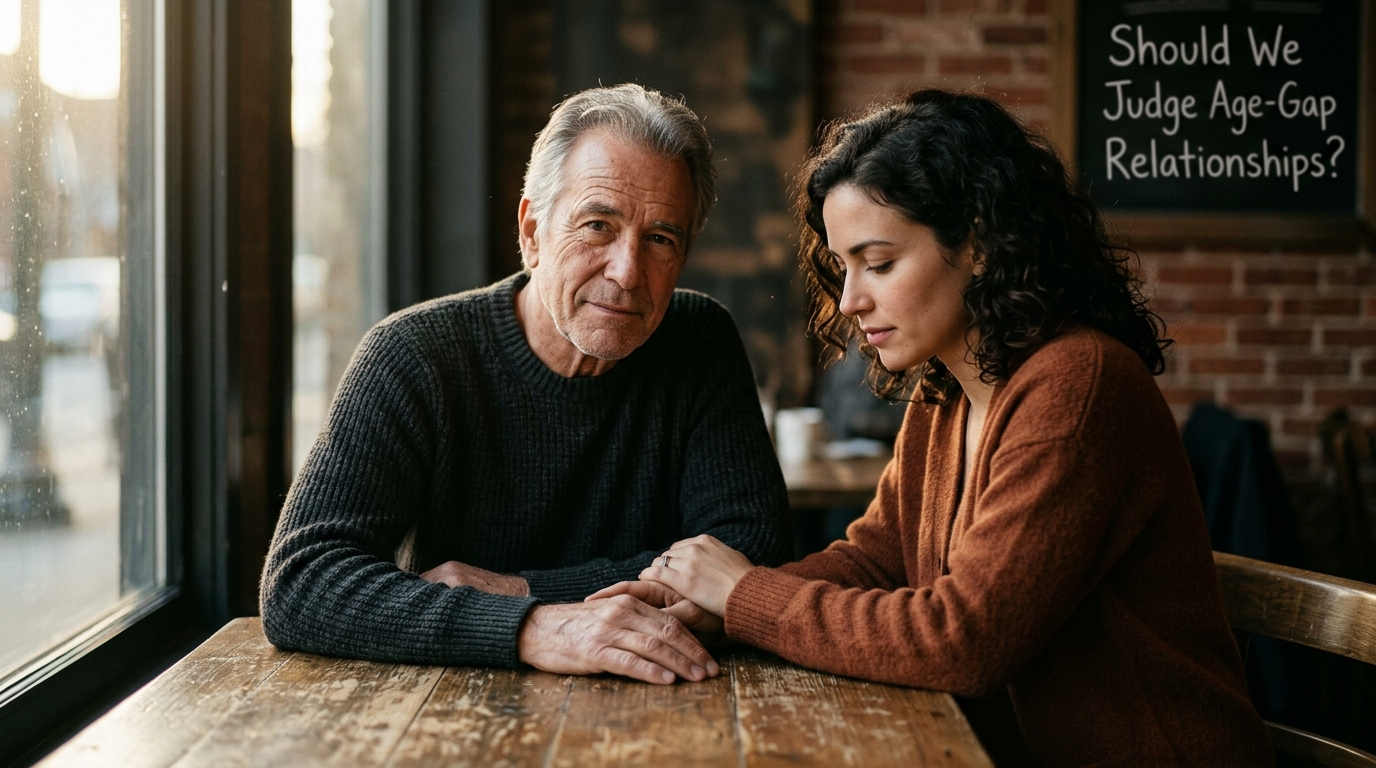
Netflix's Age of Attraction: The Architecture of the Age-Gap Romance


The air is crisp in Whistler, British Columbia. Netflix's Age of Attraction orchestrates a grand experiment among forty singles who have surrendered their government identification. They are here to test the limits of generational romance.
The premise is brilliantly simple. You cannot ask a simple question.
Age has become the ultimate proxy for power. College students in Massachusetts recently faced kidnapping charges after staging a vigilante sting against a twenty-two-year-old man pursuing an eighteen-year-old woman. Gen Z treats minor age gaps as a moral failing. The creators at Velvet Hammer Media lean into this hysteria. They strip away the numbers to see if romance can outrun social conditioning.
Executive producers Jennifer O’Connell and Rebecca Quinn know exactly what they are doing. The resulting eight-episode television event is wonderfully messy.
The aesthetic mimics a subtle, high-stakes psychological thriller.

Bachelor alumnus Nick Viall and his wife Natalie Joy serve as the masters of ceremonies. Viall is forty-five. Joy is twenty-seven. Their very presence validates the thesis of the season that premiered on March 11.
The rules of engagement are incredibly strict. Participants ranging from twenty-two to sixty years old engage in blind speed dates. The ultimate taboo is revealing one's birth year. Connections must be forged entirely on conversation and chemistry. Only after securing a match in the Promise Room do these couples move to a shared condo in Vancouver.
Then the curtain falls. The exact ages are finally revealed to the participants.
This is where the true narrative friction begins. We watch fifty-four-year-old Theresa grapple with introducing twenty-seven-year-old John to her adult children. Her oldest son is twenty-nine.
The power dynamics are rarely straightforward. Consider twenty-three-year-old Pfeiffer and forty-three-year-old Derrick. Their connection is built on quiet respect. Yet Derrick is an established professional in Texas with two children. Pfeiffer lives in Seattle. A successful union requires her to abandon her geographical existence. The gap is not just mathematical. It is deeply infrastructural.

Sometimes the older partner assumes complete control. Other times, the dynamic entirely flips.
We see this clearly with Vanessa and Logan. She is forty-nine and has survived four broken engagements. He is twenty-nine and has never brought a woman home to his parents. They jockey relentlessly for the upper hand.
Society loves to project vulnerability onto the younger partner. We assume a younger woman is easily manipulated by an older man with accumulated wealth. Psychology research suggests we view the older partner as the primary beneficiary. The show asks us to interrogate those paternalistic instincts. We must question if our disgust is rooted in actual danger or merely aesthetic discomfort with aging.
Celebrity culture has primed us for this debate. Florence Pugh felt compelled to defend her relationship with Zach Braff to her younger fans. Critics labeled the gap between Chris Evans and Alba Baptista as gross.
The public demands a thorough explanation for intensely private choices.
We form harsh judgments based on what we think people should want at different stages of life. We ignore what might be true about a highly specific situation. By withholding the age factor until the couples move in together, the producers force the audience to examine their own biases. We root for a pairing only to recoil when the math is finally laid bare on the table.

Netflix officially greenlit a highly anticipated second season. The series dominated the English TV Top 10 charts across twenty-six countries since its release.
A special reunion episode of The Viall Files podcast drops this Wednesday.
All three final couples committed to each other at the mountaintop ceremony. The cameras eventually stop rolling. The real world demands its pound of flesh. We are left to wonder if romantic chemistry can truly survive the heavy gravity of differing life stages. The experiment proves that stigma does not simply disappear just because you choose to ignore it.
Love might be blind. Time, however, sees absolutely everything.
Frequently Asked Questions
What is the premise of Netflix's Age of Attraction?
The show features forty singles between the ages of twenty-two and sixty who speed date without revealing their ages. Couples who form a connection move into a shared condo in Vancouver before deciding to commit at a mountaintop ceremony.
Who hosts Age of Attraction on Netflix?
The series is hosted by Bachelor alumnus Nick Viall and his wife Natalie Joy. They have an eighteen-year age gap themselves, with Viall being forty-five and Joy being twenty-seven.
Will there be a Season 2 of Age of Attraction?
Yes. Netflix has officially renewed the series for a second season. Jennifer O’Connell and Rebecca Quinn will return as executive producers.
Where was Age of Attraction Season 1 filmed?
The initial speed dating rounds were filmed at a forest retreat near Whistler, British Columbia. The couples later moved into a shared condo in Vancouver to test their relationships in the real world.
Are the couples from Age of Attraction still together?
All three final couples committed to each other during the finale. Updates on their current relationship status will be revealed during a special reunion episode on The Viall Files podcast this Wednesday.
Related
Articles
Readers always have access to latest trends and perspectives.








Comments: